Friday, July 5, 2013

Kill it with fire: The Worshipful Company of Cooks, Part One

The smallest of all the Livery Companies had to be the Worshipful Company of Cooks of London. Yet they did exist, so while the clay bread oven I just built is curing (more on that later) we get an excuse to play with food and fire in their name and I get to try my hand at some period recipes.

I've really been looking forward to this one.

If nothing else, this project gives me a chance to post an image from Bartolomeo Scappi instead of my muse/nemesis Jost Amman for a change. Scappi (died 1570) was the personal chef of six popes. His renown, however, is mostly for his magnum opus: Opera di Bartolomeo Scappi, Maestro dell'arte del cucinare, divisa in sei libri (roughly: "The Work of Bartolomeo Scappi, Master of the art of cooking, in six volumes"). Scappi's Opera (as it's known) is at once a gossipy memoir of life as the Vatican chef and a manual of instruction for the state of the culinary art, circa 1550-1570. It contains over a thousand recipes/preparations, and is probably the most thorough accounting of the renaissance kitchen that we have available to us.

It also includes a large number of drawings depicting kitchens both inside and outside and all the implements that one could hope to reproduce. Best of all, you can download it free from the Internet Archive. http://archive.org/details/operavenetiascap00scap


Scappi, unfortunately, was decidedly not English. So we'll be using his 'Opera' as one of many resources as we work from period or near-period English recipes wherever possible. Additionally, we'll be using some of the resources produced by the fine folks who put on the cooking demonstrations for the Historic Royal Palaces. Between Scappi and the fine folks at HRP, I think we're in good hands.

But before I get to all that, I have to learn to cook with fire.

Looking at that engraving up there, it seems simple enough:
  1. Light fire. 
  2. food over roaring fire. 
  3. Eat and repeat.
But nothing is ever as simple as it seems at first blush. If this project teaches me nothing else, it will teach me that.


Can you hear me humming "Smoke gets in your eyes"? 

Yeah...

A word about cookware and safety...

The Elizabethans didn't know a thing about bacteria or food poisoning. Their grasp on metallurgy was
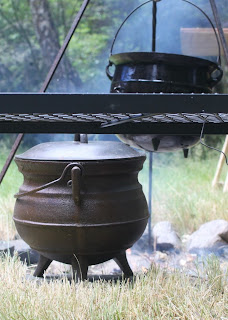
pretty good, though, and getting better all the time. Yet they used some metals and alloys with furious abandon that we now understand to be catastrophic to your health. They practically poured lead on their breakfast cereal.

Lead isn't really a relevant worry here since its use is so constrained in modern manufacturing. The place most Elizabethans encountered it was in the glazes of their ceramics and as a potter I can control for that pretty easily. My main deviation from the period is eschewing bronze entirely. Those cauldrons you see in all the paintings? Most of them were cast in the same manner as church bells and from mostly the same materials.

The biggest problem with bronze (aside from weight and expense) is that it's an alloy mostly consisting of copper. In the period it might be blended with lead or zinc, neither of which are good eats, but even modern bronze has its problems and perils. 

I use copper all the time because I have some copper cookware in my kitchen and it tends to be lined with tin if it's intended for household use. But all my cauldrons are cast iron, which is most assuredly not a period metal. Why the deviation? Because cast iron is easier to clean and care for, less expensive, and even if I screw up completely, it won't poison anyone.

Is that really a danger? Sort of... certainly more of a problem than I'm willing to bear on my conscience. When copper comes in contact with acids it can create a chemical reaction that forms what's known as verdigris.  That's the green patina that forms on copper as it weathers. And it's poisonous.

Scrupulous cleaning can keep you safe and the folks at Hampton Court Palace use bronze cookware that was made for them (I believe) by the folks at Historic Castings.

Thermal mass is the key here. As far as I can tell, the choice of metals for my cookware doesn't change the results and the transfer of heat from fire to food doesn't change all that much.

Speaking of cleanliness, I have pots to clean...

More later.

- Scott

Thursday, June 27, 2013

Learning Curves and the State of the Project: I know now why apprentices are a Thing...

Part One: History and Hubris 

History celebrates the battlefields whereon we meet our death, but scorns to speak of the plowed fields whereby we thrive; it knows the names of kings’ bastards but cannot tell us the origin of wheat. That is the way of human folly.” – Henri Fabre
That sounds familiar.

That quote, attributed to Henri Fabre[1], sits at the top of page one, chapter one in the book Six Thousand Years of Bread: Its Holy and Unholy History by H.E. Jacob. The book is a vast and noble attempt to fix Mssr Fabre’s problem, and it goes a long way toward doing so. It is the latest of many books I’ve found and wished I had and/or read before we embarked on this journey. At risk of stacking quotes, an old adage that’s often attributed to Abraham Lincoln says that the purpose of reading is to remind us that our original ideas aren’t all that original.

Touché, Mssrs. Lincoln, Fabre, & co. A hit, a palpable hit...

What 6,000 Years of Bread really does well, though, is map out a very reasonable twenty-years spent by the author trying to understand the origins of bread. And it reminds me that what I’m doing here has become less and less about the world, trade, and tools of the renaissance craftsmen and more and more about their tools.

In other words, I’ve gone about this entire thing in entirely the wrong way. 

For instance, when I ventured into the world of the Worshipful Company of Turners, I spent quite a while trying to figure out what kind of lathe to build, how it operates, and how to build one. Then I built one. From scratch.

Now, while I knew this would be part of the process, I wildly under-estimated how long it would take to build all of these tools. (Or perhaps underestimated the size of my own creative ego, you be the judge.)

The next project includes baking and cooking.

Now, I don’t know about you, but my house didn’t come equipped with an Elizabethan spec kitchen any more than it came with a wood shop, which means there’s a cob oven and hob rising from nothing in my back yard. And I’m doing everything myself except baking the bricks.

And I really ought to be baking the bricks except that I haven’t found someone with a large enough kiln yet who will let me near it. 

Which all sort of argues that my project has veered more toward a re-imagining of the renaissance as something that was invented from nothing. Or perhaps springing from some post-apocalyptic hellscape where each piece of technology has to be re-created from stuff I find lying around. 

 Mad Max, circa 1560.


Part Two: Tools and Their Users

Sometimes I feel like I’m not so much learning how an Elizabethan artisan lived his life as reenacting the 1600 odd years that preceded his life as we moved from whittling to bow lathes to springpoles and treadles and onward. Sometimes it’s a bit like studying the lives of Indy drivers and starting by learning how to make tires from scratch...

Because I’m almost literally reinventing the wheel with every one of these projects, it eats into the time I can spend actually learning about the craftsmen and the things they made. Which is fine, studying the tools is a fine thing and I’m learning a mind-blowing amount of information about fabricating my own tools. But I think that the key thing I’m learning is that this should have been two projects: a yearlong preparation stage where I build the tools and then a second year when I learn to use them to create standard period artifacts and study the people who used them.

Which isn't the worst idea I've ever had, actually.

There's an inherent drawback to inheriting your tools. You were either not alive or too young to care when they were purchased. (Actually, in my case, my grandpa was either not alive or too young to care when some of them were purchased.) So you don't have a really close relationship with that punch to the wallet that accompanies some tool purchases.

Seriously, I bought my first new hammer ever just this year.

When I first embarked on this project, I thought that with easy access to the internet, I could get my hands on anything I really needed to get a project done. Going out into the community to see if I could source things locally was a bit of a lark because I could always just order it online. And that's certainly true, as it turns out... but there's a hitch.

Take this adze for instance.


If you've never seen one of those before, that's okay; it's not exactly a common tool in modern America. An ancient tool, the adze is sort of a sideways axe, used to dig out hollows (as with a dugout canoe) or smooth a surface (as shown above).

The adze in the image above was an adze-shaped ball of rust when I found it in the bottom of a bin at a flea market. The seller thought it was a gardening tool, and priced it at the princely sum of $5.99. In the past couple of months, I've procured three adzes in precisely the same manner, and in the same state of disrepair. As followers of the Facebook feed know, I recently spent the weekend bringing them back to life.

That one tool took six hours to bring back to life. I worked the sun into and out of the sky and still wasn't finished with the smaller of the three, a cooper's adze.

It was time well spent and it makes my heart glad. This tool is truly a joy to use, as are the other two.

My forbears left me a big box of serious tools because they took their tools seriously. And even if that wasn't true, standing opposed to the disposable aesthetic is part of maker culture.

Part of what makes me... me.

I also refuse to spend the money on anything that won't survive regular use. (Except computer equipment, which is a rant for a different time.) There's no economic sense in spending a $100 for a tool that will last five years (maybe) when you can buy a thirty or hundred-year tool for $200.

This is complicated by the fact that at the outset of this endeavor, I had to agree not to bankrupt us in my quest. The Engineer is smarter than I am and always has been. She's followed me into many a woodworking store and while I was oohing and ahhhing over the figured cherry, she was flipping price tags. She knew this would not be cheap and extracted a promise from me before I caught on.

See? Smarter.

Everything I could ever possibly need is indeed available to me via the internet, but there's a catch. Real tools cost real money.


Three: The Internet & the Deep Blue Sea

As we've discussed before, when Henry VIII's flagship Mary Rose went down on July 19, 1545, she sealed for the ages a time capsule of life in Henrician England. The artifacts preserved included the tools of the ship's carpenters. Eight chests of period tools, preserved by the waters of the Solent and a strange quirk of unkind fate.

Despite there being eight chests of tools, this is not by any stretch an elaborate or even complete example of a wood worker's trade. The tools aboard Mary Rose were specific to the task of keeping her upright and fighting. Nevertheless this gives us that rarest of gifts for a project like this one: an intact example of a 16th century tradesman's tools.

Which made me wonder what it would cost if I just went out and bought the modern interpretations of those classic hand tools. Hewing as closely as possible to their historical counterparts, of course, and bearing in mind the quality standards already outlines, I pretended I had a Hollywood budget under my belt, composed a selected list of key tools from Mary Rose, and went window shopping.
Broad Axe (Woodcraft).... $300.00
Broad Hatchet (Amazon).... $125.00
Carpenter's Adze (Lee Valley).... $250.00
Hand Adze (Lee Valley)... $50.00
Wimble (A wooden brace or hand drill)... Metal varieties are a dime a dozen. No one seems to sell wooden ones anymore and anyone that wants one, makes one. Antiques are priced from $50 up.
Spoon bits (no spiral bits in the 16th Century - Lee Valley).... $80.00 for a set of five
Bow Saw (Gramercy Tools).... $150.00
Wooden Smoothing Plane (Closest I could find to the Mary Rose example - Lee Valley).... $239
Wooden Rabbet Plane (Or what looks like one in the few pics I can find online - Lee Valley).... $39.50
Marking/Mortise Gauge (Rockler)..... $49.50
Dividers (Lee Valley).... $23.00
Ruler (Primitive).... It's a stick with marks burnt into it. Can't imagine buying one from someone.
Draw Knife (Daegrad).... £ 27.99 (Call it $43.00 at today's exchange rate)
Handsaw (Northwind Toolworks).... $275.00
I stopped when the total hit $1600.00 and remember that he would also have had various nippers, pliers, clamps, and miscellaneous whatnot which were made primarily of ferrous metals and therefore lost to time and tides.

I'm not saying that my tool chest is worth anywhere near that much (because it isn't), or that these are worth that much (though they are) you can see why I rely heavily on the antique stores and flea markets. And why I jumped at a carpenter's adze for under $6.00, even if it was a lump of ferrous oxide.

Also, bear in mind that this list would just cover tools for the carpenter's portion of the project. Leaving aside the overlap with the coopers, joiners, and turners which would still add to the total. There's also cooks and bakers and embroiderers and knitters and spinners and weavers and woolmen...

Thankfully, I am only metaphorically doing this on a stage, so there's no reason for me to go out and buy the perfectly period versions of these tools unless it genuinely affects the outcome in some way. Even Peter Follansbee, the joiner at Plimoth Plantation advises aspiring joiners to get close and get on with it.


So that's what I'm doing, but it's still slow-going.

Which is why a large and growing portion of this project has been about tools. Hunting, creating, rehabilitating, tools. And if at the end of the year all I've learned or earned is about the tools and toolmaking, I suppose I'll just have to spend another year learning about their users.
And I'm going to call that a win.

With that settled, rest assured I will be posting more often in the coming weeks.

See you soon!

- Scott

----------------------
[1] Though the quote is attributed to Henri Fabre (inventor of the sea plane) in the book where I found it, I suspect that it’s actually attributable to Jen-Henri Fabre, entomologist and social commentator who also said “The common people have no history: persecuted by the present, they cannot think of preserving the memory of the past.” Which I find similarly germane to my mission.

Saturday, June 1, 2013

Turn Turn Turn, for everything there is a cliche, turn turn turn...

I apologize for my absence. I've been having a... thing. I don't believe in writer's block so it's not that, it's just... I dunno. You can read about it at Pages to Type if you want: Dumbo's Feather Revisited: Of writers and rituals otherwise, accept my apologies and let us move on to wood spinning in a circle with a blade placed against it...


The Worshipful Company of Turners

My lathe. Up close and personal...
I've never particularly liked turning. Modern lathes are fast and dangerous and freakishly expensive, which combined uncomfortably in my mind with the idea that has often been pushed on me that all woodworkers are aspiring turners.

I am not.

At least not until I discovered that I could build my own lathe, which appealed to my "Make Neat Things" aesthetic and helped me take my first hesitant step onto that slippery slope of wood turning.

The history of lathes is very interesting and rather closely parallels the history of the spinning wheel and the pottery wheel, all of which operate on much the same principals, though not necessarily in the same plane. By the 16th century, there were three kinds of lathe existing side-by-side: the fairly primative bow lathe, the springpole lathe and the treadle lathe, which I gather was a recent invention.

Almost anything that was round in Elizabethan England was turned on a lathe. Even if something was cast, the pattern from which it had been cast was probably turned. Patternmakers love wood and they love lathes.

My old nemesis/muse Jost Amman, of course, has a turner depicted at his trade. The lathe isn't well depicted, but you can just make out the springpole coming across the ceiling and the strap or string that is driving the sphere (apparently) that the guy is turning.
The turner at his trade from Jost Amman's "Das Standbuch" of 1568
I admit I'm curious about why he'd be turning a sphere. If anyone knows, leave a comment. If that's a bowl, he has it on the lathe sideways, but an engraver can't necessarily be expected to accurately depict the nuances of every trade, I suppose.

My lathe was built on the same basic plan as this one I found on Pinterest. I made the heads from two sharpened carriage bolts, which I carefully and painstakingly aligned to give a nice, flat spin for the workpiece.

The string started out secured to the springy limb of a pine tree, a suggestion made by Peter Follansbee in one of his videos, but I confess that I eventually swapped it out for a four-ply bungee rope when I got tired of being whipped by the tree for my temerity. 

Problems to Solve
As you can see from the image below, my oak billet (I'm starting small, a handle for a socket chisel) was chattering something fierce. This happens when the blade of the tool skitters across the work surface rather than biting into the wood as it is supposed. I suspect my lathe tools weren't as sharp as they needed to be in spite of my hours spent honing them. I shall return them to the whetstone again tomorrow and finish off with a good bit on some emery paper and then leather stropping.  

All else being equal, this shouldn't be happening.


Another thing I've decided to add to the design is a drive wheel. I got this idea from an article written by Roy Underhill, who explained that the diameter of the piece affected the speed of the turn. So I sat down with a bit I cut from one end of an old maple rolling pin and milled out a pulley, essentially. The trio of spikes will (theoretically) go into the small piece to be turned and drive it at a higher rate of speed. 

The concavity of the drive wheel should keep the string from creeping, which has been a bit of a problem already.


To compound my sin with the bungee, you can see that I began with a length of nylon paracord that I had lying around. It has abraded with a vengeance and I've already had to deal with broken lines and splicing new bits of line into my machine. 


I will be replacing the paracord as soon as I can with a proper bit of line, hemp if I can find it.

Once I have things worked out and in working order, I will get on with the real task, turning a small wooden bowl like the ones found on Mary Rose. But we're nowhere near there yet.

More to come.

- Scott


Late addition: 
Foot-powered lathes at The Woodwright's Shop with Peter Follansbee and Roy Underhill. Enjoy!

Watch Wretched Ratchet Reading Rack on PBS. See more from pbs.

Saturday, May 4, 2013

And then my brain tried to kill me... The state of the project.

The other day on Facebook, I promised to update soon. I promised that I wasn't dead. And because fate has a warped sense of humor, then my brain tried to kill me.

Like it often does.

So... lots to catch up on. Coffee, for instance. Haven't had any coffee since Wednesday and I have a lot of catching up to do. Also there's a kitchen sitting around in pieces that needs to be reassembled so we can, you know, cook food and stuff. Tiling and cabinets and countertops and miscellaneous whatnot await me, but coffee first. 

Because priorities, I have them.

Which brings us back to this project, and most especially this blog, which I have been neglecting, I fear.

I seriously underestimated the toll that accepting a full-time job would have on this project. Especially with all the home renovations that have to be done. The level of organization necessary exceeded my ready supply of tools.  I'm not really good at organization on this scale at home. I do fine at work, juggling huge projects that span entire years, but when I get home... something clicks off in my brain.

Just one of the many ways my brain periodically demonstrates how it hates me.

There's a horn out in the shop that's halfway to becoming a beaker, a half-made bow-lathe that needs some attention, and all the makings of a woodfired oven stacked under a tarp waiting for a dry spell so I can call out the troops to come help build it.

Anyway, I talked to the engineer, and we're trying something new.

Because real, bought and paid for, life trumps blogging projects, the bulk of my time is spoken for. There's just no way around that. Some of what I have to do for the kitchen (tile for instance) will align with parts of this project, but most of it is too modern to fit neatly into Renaissance Artisan business.

One or two days a week, however, will be devoted entirely to this project. Building, experimenting, photographing, and documenting (cough-blogging-cough) will take precedence on those days. We're still working out which days and how, but that's the plan or this is never going to work out.

Like the Facebook thingy said: "one man, 54 Livery Companies, 111 trades, 52 weeks." And we're at the end of week 18. At this rate, it's never going to work and before you propose it, I am not yet willing to entertain the idea of cutting projects. Part of the "fun" of doing this is figuring out how to do it without neglecting the day-to-day of modern life.

Anyway, that's the state of the project.

More later. I have coffee to drink and all the aforementioned projects aren't going to get closer to done by typing.

~Scott

Sunday, April 7, 2013

Time-Traveler: The man from nowhen...


"I bet you think you were born in the wrong era," she said. I smiled grimly and shrugged. I didn't want to point out to her that Everyone Says That. And it drives me just a little nuts.

As a writer, I spend a lot of time delving into the past and exploring what life was like at various points in history. I've written about WWII, Prohibition, the Great Library of Alexandria, and Shakespeare. So "Do you feel like you were born at the wrong point in history?" isn't an uncommon or even unreasonable question.

Frankly, I'm a little disappointed that since I wrote Howard Carter Saves the World no one has asked whether I felt I might've been born on the wrong planet.

It annoys me at times, but it's a fair question because if anyone was ill at ease in the modern world, it's me. Let's face it, I have a lot of skills that aren't of much use in the 21st century.

By the metric of the rest of the country, my childhood was more on like my dad's than it was like the rest of my peers. We didn't have a video game system or a computer of any kind. Dad didn't believe in video games and didn't like computers. I learned to type on a typewriter (as is right and proper) and only saw digital systems when I went to a friend's house or a mall.

My friends refer to this as a 'sheltered upbringing' but I'm not sure I'd agree.

I spent a lot of time at my grandparents' farm where grandpa taught me woodworking to keep me out from under foot and where I made a lot of my own toys. I built rafts because I read a lot of Huck Finn. They all sank or broke apart, so I swam to shore and built new ones. It was a world of pocket knives, toy guns, frogs, wooden airplanes... I played with GI Joe while we listened to Fibber McGee & Molly on the radio. I watched Star Wars like every other kid of my age, but read voraciously from a library that was stocked mostly with books written over a half century before I was born.

My childhood was a Mark Twain novel ghostwritten by Ray Bradbury, filtered through an Archie comic.

The world that was shown to me on TV seemed distant and somewhat surreal, simultaneously more modern and less than the world around me.

I still prefer hand tools to electric, my typewriter to my laptop, and a printed book to a digital one. I have no real attachment to those wonders of modern technology that people around me can't live without. I don't own a cell phone, though The Engineer has one. It's not inarguable that I really am a man out of my era and I wouldn't blame you if you thought that if given a time machine and license to use it that I'd be off like a shot.

I certainly used to think so. I may have been misplaced several centuries! I said as much to my dad once. Dad, who had very little tolerance for bullshit, looked at me and kind of snorted and said "Take off your glasses."

Touché, Dad

I have allergies and poor eyesight and I have an asthma inhaler in my pocket as I type this. Even when I join in a historical reenactment and try to sink into a past age, never far from my mind is the fact that I never would have survived childhood in these past worlds.

Books are my time machine along with projects like this one. This is my preferred method of time travel. If someone offered me a trip through time I might not take them up on it if I cannot close the cover and return to the modern era any time I wish.

And it's not at all about the asthma inhaler. The women around me are valued as highly as the men. My wife is an engineer. My boss is a woman.  I can see someone passing me on the street and talk to them without my judgement of them stopping at the color of their skin. I can say whatever I want here and as long as I don't libel anyone, no one can stop me.

Because honestly... the 'good old days' weren't that good.  The Elizabethan era may have birthed the modern world, but it was still firmly anchored in the medieval. The streets stank of the latrine, death stalked the streets, the laws were Draconian and the punishments cruel, the cast system was becoming porous, but only just.

So until the man in the Blue Box comes to escort me to the opening night of Hamlet and then safely home again... I like this time period just fine, thanks.

Frankly, I like it here. The people are mostly friendly, the medicine is pretty good, and I don't have to worry about people teleporting into my house unannounced yet.

---
This post first appeared in a slightly different form on my writing blog Pages to Type Before I Sleep... in February of last year. People keep asking the question, though, so I find myself continuing to answer it.    ~Scott

Thursday, April 4, 2013

The Dog Ate My Homework...


So, the part of this I've been slacking on is the 'blogging regularly about things' part. It's a beautiful spring in the Pacific Northwest, and I've been trying to clear a backlog of projects all at once. That backlog includes our kitchen... which won't become germane to this project until I get the floors done so I can start building cabinets.

Which should be next week.

I also wrote this piece as a guest on the blog of urban fantasy & folklore author Maggie Secara, which is directly related to what we're doing here: To Knit or Not to Knit.

In the meantime, there's a pile of bricks and clay in the back garden that will become an oven soon. I've refurbished half of my hand planes (which is enough to get some cabinets going) and the chisels are ready for some handles that I'll be turning on that new lathe I'll be building.

The next phase will be divided between the domestic staff and the people who build the houses and shops the domestic staff lived and worked in:
  • The Bakers, Cooks, and purveyors of various foodstuffs
  • The Carpenters, Turners & Joiners
Stay tuned.

~Scott

Sunday, March 24, 2013

Elizabethan Knitting: A Monmouth Cap

It's probably safe to say that knitting isn't going to be a hobby I'll be continuing on with in any serious way. Every craft is essentially built on the premise that the particular sort of fussiness and tedium that it brings to the table sits just below your tolerance level for monotony. Knitting is just not my particular brand of tedium.

I'm sure that's not the last time I'll say that.

Be that as it may, it's time to finish off the Monmouth cap and move on to the next craft.

Just a reminder that I'm using a pattern provided by historical knitter Jennifer L. Carlson here with some backup from The Engineer's years of experience and her multi-volume knitting library. We've taken some minor liberties with the pattern (like you do) and I'll get into those below.

The results might be imperfect, but as I always say when crediting sources in the afterword of a book: My sources are infallible within their professional realms, my hands are less so; any errors are my own.

The Monmouth Cap

For her demo hat, Ms. Carlson used Lion brand "Quick & Thick" yarn, which The Engineer tells me is a synthetic fiber. To get a similar gauge, she advised me to switch to wool and use two strands instead of one.

At some point, I plan to card and spin my own yarn (Woolmen's Company, here I come!) but for this project we're working "off the shelf" with Paton's Merino Wool in an 'oatmeal' color. It's a worsted weight, size #4 wool, 3.5 ounces per 223 yards. All of which is essentially meaningless to me, but she tells me it's important information for other knitters.

Working with double-strands is a bit of a pain in the butt, or at least it was for me. I kept getting the needle through one loop of the two and having to back up to where I dropped half a stitch. The Engineer tells me that my problem is that I'm a "tight knitter" and I need to ease off the tension a bit.

Step one: Cast 90 stitches onto three double-pointed needles like we did here. Leave an extra long tail, because Monmouth caps traditionally have a weird loop at the back because early modern knitters enjoyed having a big tail of trailing wool to get tangled in.

I know what everyone is thinking: Yes, I have a snoopy lap quilt. You may die of envy now.
Three needles is because this project is knitted "in the round", though as you can see, they should call it "in the triangle" because that's what it is. (The Engineer tells me I'm not allowed to rename centuries-old knitting procedures, but I think Pythagoras has my back on this one.)

The little pale pink, blue, and white circle thingies are stitch-counters. They're that color because knitting companies like to discourage male knitters, I think. I placed them every ten stitches.  Make sure to mark your beginning because it's how you're going to count as you go round and round.

Step two: Knit for five inches, moving round and round from needle to needle. Do this by knitting onto a fourth needle. As you work the stitches off each needle, that one becomes the fourth needle in your... square.

Okay, it's knitting "In the polygon" are you happy? It's still not a circle. (Fist bumps Pythagoras.)

Note: A small tablet computer isn't really mandatory for this process, though it's handy if you want to consult your online pattern without dragging out a real computer. Also: you can watch endless repetitions of favorite TV shows you've seen a million times before. The Engineer assures me that this is an integral part of knitting that I'm not allowed to mess with. Who am I to argue?
By the way: This pattern doesn't use the purl stitch, so I guess we learned that for nothing.

Step Three: When you get about five inches into your knitting, you can get that blasted tail out of your way by turning it into "I-cord", which is knitting back and forth four stitches at a time to make (basically) a teeny-tiny scarf, which you'll weave back into the middle of the bit of hat you've knitted for your loop.

I didn't take any pictures of that because I forgot to do it. I put up with that stupid long tail for the whole of the hat and then did it last. If you decide to make one of these hats, you should do as I say, not as I do.

Then you'll fold your knitting in half and knit the ends together to form the headband. The patterns warns that "this is the tricky part" which is an understatement. I think that the biggest problem was that I'm knitting with doubled yarn, so instead of picking up two stitches, I'm picking up for.

I managed it without screwing up for all of four stitches before handing it to The Engineer, in peril of my immortal soul from all the sublimated cursing.

We didn't take pictures of that either. (sigh)  Ms Carlson has plenty of excellent pictures of this process on her site, though.

Step Four: Just keep swimming. knit and knit and knit and knit, round and round and round he goes until you have something that you can kinda/sorta put on your head...

It's helpful if you can hypnotize the cat to sleep and ignore the bag of jelly beans next to him. 
Step Five: Reductions. On row 46, you'll start the kind of knitting that you have hitherto treated as a grievous error. This means you'll knit as usual for four stitches and then force your needle through two stitches at once, thus reducing the number of stitches on your needle and the circumference of your circle.

Yes, the knitted results of your triangle/square/amorphous polygon is a circle. That's why they call it knitting in the round, of course. Sorry Pythagoras, it was a good run and a thousand years of knitters are sneering at us for questioning their collective wisdom.

Kids these days! I tell you...

These reductions happen gradually. First knitting together every four stitches, then every three, then every two and finally all of them until you have aching hands and a headache from passing a half dozen stitches between three needles THAT ARE JUST TOO DARNED LARGE TO DO THIS WITH!

(Deep breath.)

At this point, you can cast off to form a button as she indicates in the pattern, or you get to switch to a big needle and sew it together like I did.


Jelly beans aren't mandatory, but are advised for sustaining the soul while knitting.
As you can see, my results were a bit big, so we felted it. 

I'll go into the science of fulling/felting when we get to weaving. At the moment, we'll suffice to say that it's about agitating your knitted object in a basin of hot water with some kind of medium (we used detergent) to get the wool fibers to shrink and lock together into a more or less solid mass that you can then drape over a form to dry.


I'm rather proud of it and looking forward to never having to do it again because that wraps up the cappers guild and rounds off the Worshipful Company of Haberdashers. 

As you can see in the background there, I'm remodeling a kitchen and we have the worshipful companies of carpentry and joinery ahead of us. Sooner for me than for you, as you can see...


~ Scott